
Thursday, December 20, 2012
#Reverb12 My Dream List in 2012
Off Of my dream list for 2012 was starting this very blog with my best friend and learning how to make homemade soap! I am still learning the ends and outs of soap making but hopefully next year will continue to improve that skill!
Oh and the best part of about 2012 is this little guy right here..my little puppy Abraham..I just love my little fellow!
 I haven't really thought about what I would like to blossom in 2013...So I believe that I better get the gears turning and thinking about what are my top three dreams I want to make a reality for next year!

Wednesday, December 5, 2012
7 Superfoods for Longevity
We all want to live longer and one way to make our chances more propitious is by being more conscious about what foods we are putting inside our body. Here is a info-graph of seven super-foods that could be integrated into your diet on a regular basis.

Source by JES Restaurant Equipment

Source by JES Restaurant Equipment
Tuesday, October 30, 2012
Herbal Myths and Legends
Since Halloween is tomorrow, The Feisty Organics thought it would be neat to share a few herbal myths and legends. Don't worry these stories won't leave you clinging to your favorite teddy bear at night but, hopefully they will make you appreciate the important part that plants and herbs play in history and folklore.

Fennel Plant- Greek legends believed that Prometheus hid the heat of the sun in the hollow stems of the fennel to bring it from heaven to our lovely earth. Fennel also was thought to offer protection against witchcraft.
Lavender- According to legend, When Jesus was an infant, Mary laid his clothing upon a bush to dry and the scent got on his clothes. Afterwards, the plant became known as a herb to avert evil. During the time of the black plague , Lavender was worn on the wrist as protection from the bubonic plague.
Dill-In medieval times, dill was used by witches for many of their spells and charms. It also was used as protection from spells, drinking dill water, was a means to remove a spell. Bathing in dill was also considered a way to seduce a love interest. In ancient Roman and Greek cultures, dill was a sign of wealth and power.
Basil- Need protection from a dragon anytime soon? Ancient Romans called basil, "Basiliscus,"after the fiery dragon Basilisk.Legend has it, Basilisk could kill people just by his gaze. It was believed that consuming basil would offer protection from this dragon. Hindus believed basil was their passport to heaven. Building a house on a spot where basil was grown was thought to bring good fortune. However, digging up that basil plant.... I'm sorry , bad luck for you!
Other Herb myths and legends
There are many more myths and legends related to herbs that could've been addressed here but, we would've ran out of space! However, if you are interested in reading more than a good book to read is " The Meaning of Herbs: Myth, Language and Love," by Ann Fields and Gretchen Scoble.
Tell us..Do you know any good myths or legends?

Fennel Plant- Greek legends believed that Prometheus hid the heat of the sun in the hollow stems of the fennel to bring it from heaven to our lovely earth. Fennel also was thought to offer protection against witchcraft.
Lavender- According to legend, When Jesus was an infant, Mary laid his clothing upon a bush to dry and the scent got on his clothes. Afterwards, the plant became known as a herb to avert evil. During the time of the black plague , Lavender was worn on the wrist as protection from the bubonic plague.
Dill-In medieval times, dill was used by witches for many of their spells and charms. It also was used as protection from spells, drinking dill water, was a means to remove a spell. Bathing in dill was also considered a way to seduce a love interest. In ancient Roman and Greek cultures, dill was a sign of wealth and power.
Basil- Need protection from a dragon anytime soon? Ancient Romans called basil, "Basiliscus,"after the fiery dragon Basilisk.Legend has it, Basilisk could kill people just by his gaze. It was believed that consuming basil would offer protection from this dragon. Hindus believed basil was their passport to heaven. Building a house on a spot where basil was grown was thought to bring good fortune. However, digging up that basil plant.... I'm sorry , bad luck for you!
Other Herb myths and legends
There are many more myths and legends related to herbs that could've been addressed here but, we would've ran out of space! However, if you are interested in reading more than a good book to read is " The Meaning of Herbs: Myth, Language and Love," by Ann Fields and Gretchen Scoble.
Tell us..Do you know any good myths or legends?
Tuesday, October 23, 2012
Fresh Basil: 3 Unique Uses
We all know that the herb basil is a ingredient frequently used in a plethora of Italian cuisines.It is also best known for its scent and distinctive taste. There are over 150 varieties of basil.However, sweet basil is the kind typical found in stores and kitchens. Aside from being a culinary herb, there are many other unique uses and fresh basil health benefits.
 Tea-Basil leaves can be used to make herbal tea. Basil tea is a great natural remedy for tension headaches. Basil tea that has been cooled can also be used as a rinse for mouth infections.
Bug bites-Basil can be used to relieve itchy mosquito bites. Just mash or chew a few fresh basil leaves until soft. Place the poultice directly on the insect bite. For me, this home remedy has come to my aide after many afternoons spent at the park hiking.
Vinegar- The holy basil variety can be used to make a medicinal vinegar. To make the vinegar just combine unpasteurized apple cider vinegar with holy basil leaves in a jar. Place the jar in a warm sunny spot for 3-4 weeks. Then, strain and re-bottle. Holy basil is used for improving vitality and restoring energy.To use just pour a couple of tablespoons of basil vinegar over a salad. Also, you can blend it with veggie juice or drink 1/4 cup straight.

Bug bites-Basil can be used to relieve itchy mosquito bites. Just mash or chew a few fresh basil leaves until soft. Place the poultice directly on the insect bite. For me, this home remedy has come to my aide after many afternoons spent at the park hiking.
Vinegar- The holy basil variety can be used to make a medicinal vinegar. To make the vinegar just combine unpasteurized apple cider vinegar with holy basil leaves in a jar. Place the jar in a warm sunny spot for 3-4 weeks. Then, strain and re-bottle. Holy basil is used for improving vitality and restoring energy.To use just pour a couple of tablespoons of basil vinegar over a salad. Also, you can blend it with veggie juice or drink 1/4 cup straight.
Word of caution
Remember to always speak with your physician before taking any herbal products , if you have a pre-existing illness or if you are pregnant or nursing.Saturday, October 20, 2012
Saturday Evening DIY Projects
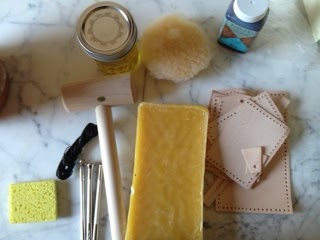 |
| I am super excited so I just had to share some projects going on this Saturday evening . |
 | |||||||
| Beeswax anyone? How about some leather wallet making? The ultimate DIY nerd. |
Wednesday, October 17, 2012
Tincture Making 101
Way back when butter was churned and clothes were sewn by hand conveniences like Wal-greens ,medical clinics and an abundance of medicine choices were non-existent. People relied on nature to provide them with various plants,herbs,barks,flowers, and seeds that could be used by herbalist or regular people to create medicines to treat different ailments. One such way they would make medicines, was to make herbal tinctures. Herbal tinctures are a mixture of different herbs and an alcohol such as, vodka or gin. You also can mix your herbs with vinegar if alcohol doesn't suit your fancy.
Tincture Recipes
Deep Sleep Tincture ( this is one of the ones we made)
A natural remedy for you insomniacs with love
1. chop the herbs really well ,Place the finely chopped herbs in a clean glass jar.
2. Pour enough alcohol over the herbs to cover them by 2-3 inches, and then seal the jar with a secure lid. If the alcohol amount decreases over the course of 2 days, you may add more alcohol to the jar and then reseal.
3.Place the jar in a warm, sunny spot and let the herbs soak for 4-6 weeks.
4. Strain the herbs from the liquid. Pour the liquid into a clean dark colored jar and store. Alcohol based herbs will keep for many years.
To use
-Take 1 teaspoon an hour or so before bed and another right at bedtime. You may dilute the solution with juice or water.
Now you tell us. What are some herbal remedies that you use at home?
Are herbal tinctures safe?
Herbs usually can be found in a number of teas that are sold at your local grocery store ,but with any plant you must know what it is before you try and consume it. Another factor to consider with herbal tinctures is that herbs increase potency with time so a few drops when you need it goes a long way instead of downing the whole bottle.Where can I buy herbal tinctures?
If you are not ready to venture out in the herbal world and make your own bottles of tinctures then your in luck. Herbal tinctures are still being manufactured and sold in a number of different alternative health food stores around the country. However, the ones sold in stores do not contain any alcohol and aren't as strong..JPG "Herbal Tinctures") | ||
| This is a couple of tincture recipe that we tried a couple of weeks ago. |
.JPG "ginseng root") | ||
| This is our hops (fyi Hops is used to make beer so your already drinking an herb!) and ginseng root . |
Tincture Recipes
Deep Sleep Tincture ( this is one of the ones we made)
A natural remedy for you insomniacs with love
- 1 part valerian root
- 1/2 part hops
- 1/4 part lavender
- 80 proof alcohol (vodka or gin will do)
1. chop the herbs really well ,Place the finely chopped herbs in a clean glass jar.
2. Pour enough alcohol over the herbs to cover them by 2-3 inches, and then seal the jar with a secure lid. If the alcohol amount decreases over the course of 2 days, you may add more alcohol to the jar and then reseal.
3.Place the jar in a warm, sunny spot and let the herbs soak for 4-6 weeks.
4. Strain the herbs from the liquid. Pour the liquid into a clean dark colored jar and store. Alcohol based herbs will keep for many years.
To use
-Take 1 teaspoon an hour or so before bed and another right at bedtime. You may dilute the solution with juice or water.
Now you tell us. What are some herbal remedies that you use at home?
Sunday, October 14, 2012
Herbalism: A Brief History of Herbal Medicine

What is the history of herbal medicine?
Throughout history ancient civilizations have documented various herbs that were beneficial to their society.In 1500 B.C., the Egyptians wrote what is known as the Ebers papyrus , which has over 850 plant medicines documented ,including ones that are still utilized today such as, garlic,aloe vera, and castor bean.
1900 B.C. In India, turmeric was used in Ayurveda medicine. Today there are 71 clinical trials underway or completed studying the medicinal uses to turmeric.
Middle Ages- Monastery scholars in Europe transcribed ancient Greek and Roman text so they could preserve information on medicines. Medical schools or Birmaristans began to appear in the 9th century in Persia.
1900 A.D.- Post World War I brings the discovery of penicillin and expansion of the international pharmaceutical industry. Herbal medicine starts to decrease in popularity as many societies turn their focus to medicines that are made chemically.
Today- According to the World Health Organization ( the WHO) , 80% of some countries in Africa and Asia use herbal medicine. Twenty-five percent of modern drugs are also produced from plant components.The interest in herbal medicine has begun to grow again due to the accessibility, affordability and because herbal medicine is now considered a healing art for the people.
What are the benefits of herbal medicine?
- Herbal medicine helps us to live a more natural lifestyle that is more self reliant.
- Herbs produce less side effects than conventional medicine.
- Herbs can be used to improve your overall health.
How can herbs be used?
Herbs can be taken as a daily supplement, herbal tea, and in medicinal infusion. You also can make salves,oils,pills,compresses,poultices,ointments,tinctures,syrups, and creams using different herbs. Also, herbs may be used together to effectively treat illness.
What is herbal medicine good for?
Herbal medicine is used to treat a variety of medical conditions , such as; irritable bowels, chronic fatigue, insomnia, migraines,rashes,allergies,PMS, eczema, and many other conditions that weren't mentioned.Knowing that medicinal herbs are very effective, The Feisty Organics have decided to do a blog series dedicated to herbal remedies. We are very excited about writing on this topic and hope you enjoy reading the various articles we will be posting!
Tell us your thoughts.What are your opinions on herbal medicine?
References
Tapsell LC, Hemphill I, Cobiac L, et al. (August 2006). "Health benefits of herbs and spices: the past, the present, the future". Med. J. Aust.
Subscribe to:
Posts (Atom)


.JPG)


